|
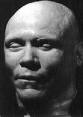
Pursuant to the sentence passed in the High Court of Justiciary, on Wednesday morning (28th) Burke suffered the last sentence of the law, at the common place of execution, head of Libberton's Wynd. From the hour in which he heard that his associate Hare was to be admitted an evidence against him, he abandoned all hopes of aquittal, and resigned himself to his awful fate. When consigned to the silence and solitude of his cell, he eagerly availed himself of the consolations of religion, and sedulously prepared for the awful change he was soon to undergo. Sincerely anxious to hear of the promises of pardon and acceptance which the gospel holds out to the contrite and repentant sinner, on one occasion when a Catholic Priest and the Rev Mr Marshall arrived at once at the jail, he exclaimed "Admit them both." In a short time, however, he dispensed with the visits of Mr Marshall, and resolved to die professing the faith of his forefathers. Though he talked freely over his murders, at all times, he spent much of his time in reading such books as were left by his spiritual instructors, and in deep and serious meditation. Heavily manacled as he was, and confined to the murderer's diet -- bread and water, he uniformly manifested an astonishing calmness and contentment. One gentleman, by whom he was visited, remarked that his cell was very cold, "Yes,yes" he promptly replied,"but since matters have come to this, I must bear it all." Though dreadfully afflicted by an excruciating disease, and tormented by the approach of an ignominous death, he acted with deliberation, and talked with perfect coherence at all times. At an early hour on Tuesday he was conveyed in a coach to the lock-up house, a prison immediately adjacent to the place of execution. He spent the day in silence, reading and devotion, and on Tuesday night he slept soundly for several hours. Immediately after he awoke, he commenced a religious conversation, in the course of which he stated, that he was happy that he had at last been arrested in his career in crime, and brought to justice. Though he had been a great offender, yet he rested on the atonement of the Saviour for salvation. It was formerly mentioned, that whilst in Lock-up House, he expressed the greatest dread of the heavy irons with which he would be loaded for the span he had to live.
About half past five o'clock he expressed a strong desire to be relieved from his fetters, complaining of their weight. This earnest wish was complied with. When he was holding out his leg his fetters fell from it, and he exclaimed,"Thank God these are off, and all will be off shortly."He afterwards said with earnestness, apprently impatient at the suspense in which his mind was held,"Oh that the hour was come which is to separate me from this world." About seven o'clock the two Catholic clergymen arrived and were admitted into the cell, and they were soon followed by the Rev Mr Marshall. In the course of the religious exercises, the priest endeavoured to comfort his mind, and exhorted him to "confide in the mercy of God." This expression appreared to touch some peculiar chord of sympathy in the prisoner's breast, and drew from him a deep sigh, which seemed to bespeak some sudden and indescibable, though momentary distraction of mind. Previous to being pinioned, he expressed the warmest gratitude to the Magistrates for the spiritual consolation they had afforded him, and also to Captain Rose, the governer, and Mr Fisher deputy governer of the jail, for the kindness and humanity with which they had indulged him, so far as was consistent with the stern sentence of the law. In retiring to another apartment, he was accidently met by the executioner, who stopt him rather unceremoniously, upon which he said," I am not just ready for you yet." He was, however, followed by Williams, and returned shortly afterwards with his arms pinioned, but without any change in his demeanour. While the executioner was discharching this part of his duty, Burke made no remark, except to tell him that his handkerchief was tied behind. He was then offered a glass of wine, which he accepted, and drank, "Farewell to all my friends," and then entered into conversation with Mr Marshall and Mr Porteous.
Shortly after midday, on Tuesday, preparations commenced at the place of execution. Strong poles were fixed into the street,to support the chain by which the crowd was kept at due distance, and on this occasion the space enclosed was considerably larger than usual. By half past ten o'clock at night, the frame of the gibbet was brought to the spot, and as the night was very wet, there was no time lost by the workmen, and by 12 o'clock, the whole preparations in this department were completed. So exceedingly anxious were all ranks, that in utter disregard of the "pelting of a pitiless storm," the operatives were constantly surrounded by a great assemblage. When their labours were finished, the crowd evinced their abhorrence of the monster Burke, and all concerned in the West Port murders, by three tremendous cheers. By six o'clock a number of people had taken their places, resolved to brave the inclemency of the weather, rather than lose a satifactory view of the execution. For some days previous, great interest had been used to obtain windows commanding a full view of the scaffold, the cost varing according to local position from five to twenty shillings, Crowds of people continued to arrive, not only from all parts of the city, but from all the neighbouring towns, and by eight o'clock there was certainly not less than 20,000 persons within view of the scaffold, among whom were an unusal number of females. The scene at this time was deeply impressive. No person could without emotion survey such a vast assemblage, so closely wedged together, gazing on the fateful apparatus, waiting in anxious and solemn silence for the arrival of the worst of murderers.
Shortly after eight o'clock the procession set out for the place of execution. Bailies Crichton and Small, with a party of town officers, first ascended the scaffold, and they were followed by Burke, supported by the Catholic Clergymen, more from the difficulty of walking, owing to his arms being pinioned, than from any inability, or any faultering in his steps, but he was as pale as death. He was dressed in decent black clothes, and was, perfectly firm and composed. when he arrived at the head of Libbertons Wynd, his face had an expression of wildness and anxiety, as if he were uneasy and uncertain of his reception from the mob, he then hurried on with his eyes half closed, eager apparently to bring the fatal scene to a speedy close. The moment he appeared, the crowd set up an appaling shout, which continued for several minutes. The murderer and the clergymen then knelt down, and spent a few minutes in devotion, and the religious exercises were concluded by a prayer from the Rev Mr Marshall. During the time a deep silence prevailed among the assemblage, but the devotions were suceeded by vehement cheering from every quarter, mingled with groans and hisses. When the cheers had subsided, the wretched man was assailed with every epithet of contempt and abhorrence. As soon as the executioner proceeded to do his duty, the cries of "Burke him, Burke him, give him no rope," and many others of a similar complexion, were vociferated,voices loud with indignation. Burke in the mean time stood perfectly unmoved , and gazed around till the cap was drawn over his face, and shut the world forever from his view. The executioner having completed his preparations and placed the signal in Burke's hand, the magistrates, ministers, and attendants left the scaffold.
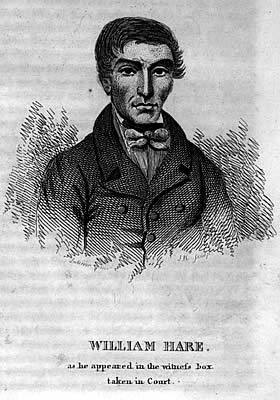 The crowd, again set up another long and loud cheer, which was followed by cries for "Hare," "where is Hare" "Hang Hare" and so on. While this was going on, one of the priests said to him "Now say your creed; and when you come to the words 'Lord Jesus Christ' give the signal, and die with his blessed name in your mouth." During all this time, shouts were heard of "Burke him," "Do the same for Hare." When the executioner was about to unloose his hankerchief, in order to adjust the rope, Burke said to him,"The knots behind"; which were the only words he uttered, not devotional, on the scaffold. Burke lifted his hands, muttered a prayer then dropt the napkin, and momently the drop fell.The struggle was neither long nor apprently severe; but at every convulsive motion a loud huzza rose from the multitude, which was several times repeated even after the last agonies of humanity were past. During the time of the wretched man's suspension, not a single indication of pity was observable among the vast crowd - on the contrary, every countenance wore the aspect of a gala day, while puns and jokes on the occasion were freely bandied about, and produced bursts of laughter and merriment not confined to the juvenile spectators alone. "Burke Hare too !" "Wash the blood from the land !" "One cheer more !" and similar exclaimations were repeated , until the culprit was cut down at about nine o'clock when the crowd started to disperse.
Footnote: Sixteen murders were credited to Burke and his accomplices, his mistress Helen Macdougal, Margret Hare, and William Hare, all had to leave Scotland for their own safety.
TOP
Home Page
Welcome Page
 doobydoo@pastechoes.co.uk ©
|